Introduce Yourself (Example Post)

This is an example post, originally published as part of Blogging University. Enroll in one of our ten programs, and start your blog right.

You’re going to publish a post today. Don’t worry about how your blog looks. Don’t worry if you haven’t given it a name yet, or you’re feeling overwhelmed. Just click the “New Post” button, and tell us why you’re here.

Why do this?

  • Because it gives new readers context. What are you about? Why should they read your blog?
  • Because it will help you focus you own ideas about your blog and what you’d like to do with it.

The post can be short or long, a personal intro to your life or a bloggy mission statement, a manifesto for the future or a simple outline of your the types of things you hope to publish.

To help you get started, here are a few questions:

  • Why are you blogging publicly, rather than keeping a personal journal?
  • What topics do you think you’ll write about?
  • Who would you love to connect with via your blog?
  • If you blog successfully throughout the next year, what would you hope to have accomplished?

You’re not locked into any of this; one of the wonderful things about blogs is how they constantly evolve as we learn, grow, and interact with one another — but it’s good to know where and why you started, and articulating your goals may just give you a few other post ideas.

Can’t think how to get started? Just write the first thing that pops into your head. Anne Lamott, author of a book on writing we love, says that you need to give yourself permission to write a “crappy first draft”. Anne makes a great point — just start writing, and worry about editing it later.

When you’re ready to publish, give your post three to five tags that describe your blog’s focus — writing, photography, fiction, parenting, food, cars, movies, sports, whatever. These tags will help others who care about your topics find you in the Reader. Make sure one of the tags is “zerotohero,” so other new bloggers can find you, too.

Simple steps to Create outstanding website content

Creating outstanding website content in 3 steps

 This is the fine and  content marketing not only drives new visitors to your web site or blog, but also gets the previous visitors to come back. A content strategy is king, so take advantage of these tools that can help.

An easy way to earn money while you create thoughtful content for your visitors, followers online  Click here for more info to earn

1. Get your high potential idea

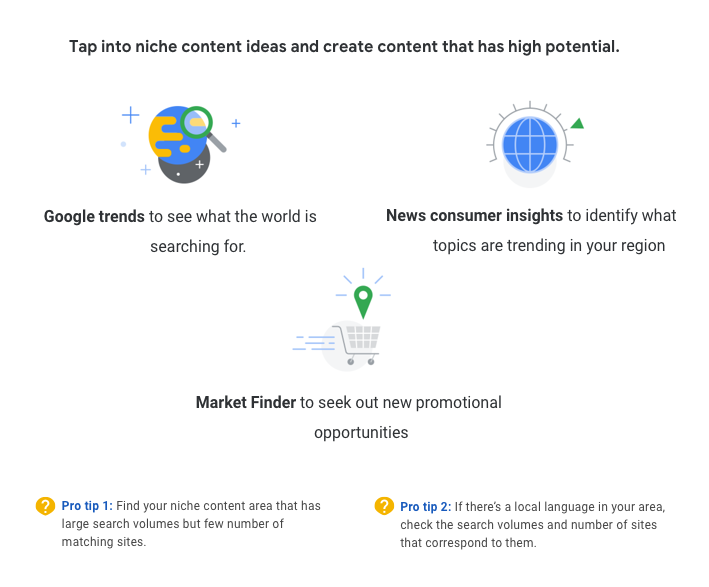
Before you sit down to create any new website content, understand the interests and content consumption behavior of the users you’re aiming to reach. Find areas that offer the most potential. For instance, niche content ideas—those that have large amounts of interest or queries but few matching sites—are often worth tapping into because they offer a way to make your content stand out. 


Google Trends shows what the world is searching for. It analyzes the popularity of top search queries in Google Search across regions and languages, and presents graphs to compare a query’s search volume over time. Keep up with trending searches, or enter any search term to discover related topics and queries. These techniques can give you a feel for what people are interested in so you can tailor your content to suit.


Google Question Hub collects unanswered questions directly from users to identify content gaps online. Use these insights to create better content for your audience.


Market Finder uncovers new opportunities to take your business global. It analyzes monthly searches, popular market trends, disposable income per capita and number of internet users by country to help you prioritize where your products, services and content will appeal most. Pinpoint a shortlist of promising new target markets for your brand and extend your site’s content to international users. 


News Consumer Insights provides analysis about which traffic sources drive the most qualified users and how to better engage your visitors. For instance, when NCI shows that the number of visits per user is high but pages per visit is low, it’s a signal that your internal re-circulation could be better. Put links to your best performing content at the bottom of articles and invite readers to click.  
Rules: All content must adhere to Webmaster Quality Guidelines.

2. Improve your content marketing


Get to know your audience and how they engage with your site so you can see what’s working and what isn’t, then improve your content strategy accordingly. Google Analytics includes a host of free tools to help you build a more complete picture of your users and identify areas where you could be doing better.
Remember the work you have to put in to make your visitors or followers to get benefited always, What you give is you get more….Earn with Content

3.  Learn from the latest tips and trends


Don’t forget to look at the bigger picture, including how people’s use of the web is evolving and how other businesses are responding.

Consumer Barometer shows how, when and why people around the world use the web. An evolving storehouse of online research and resources, it includes everything from country-specific data on consumers’ device preferences to insights about how people are making their purchase decisions.

Success stories provide inspiration and ideas from the wider community, showing how other people are using Ad Sense to help fund their passions

Summary

These are the 3 easy steps to make your website known to the whole world. Isn’t that makes you feel proud when your content is seen by millions of people- and you are popular out of your hard work.  The source has been extracted from google blog for references.

How to earn through Google AdSense?

How to earn money with Google Ad Sense ?

1. Create unique content as you are unique

For starters, your site could be initially approved by Google Ad Sense, but later reviewed for quality assurance. In other words, you can’t fill your site with low-quality content to get 100 pages indexed and monetized.


Instead, find something you are passionate about and find other people who are passionate about the same thing. Then work together with them to create the kind of content that other people who are passionate about that topic would want to read


2. Make website or blog from unknown to known


Visitors to your website might not click on your Ad Sense ads right away, and if they leave after looking at just one page, you’ve likely lost them and their potential Ad Sense earnings forever. That is why you need to create a site that is sticky.


What this means is you need to make sure that every visitor that comes to your site wants to dig deeper and deeper into the site. There are several ways to do this. For starters, have clear navigation at the top of your site so that visitors can find the best parts.
Next, make sure that every piece of content links to more pieces of content. That way, if your visitor isn’t enjoying the page they landed upon, they might see a link to another topic they would be interested in instead.
Finally, have more content links in the sidebar. Let your visitors know what your most popular content is, what your most shared content is, and what your most commented upon content is. Visitors will be curious why those particular pieces of content are so popular, and that will keep them on your site even longer. And the more times your pages get loaded, the more ads they will see, leading to more potential Google Ad Sense earnings

3. Give visitors multiple channels back to your site.

Don’t let your visitors forget about your site. Your header, sidebar, end of content, and footer are the perfect places to include multiple channels that visitors can connect with you so they can follow you. 

You should include options such as email opt-ins and social networks. That way, each time you produce or promote a piece of content, you can remind your visitor about your site and hopefully get them back to potentially click on more of your AdSense
ads.

4. Optimize your user experience.

One thing that hurts many site owners is user experience. You may have the greatest content and the best ad placement possible, but if your site doesn’t load on mobile devices or loads slowly, you could lose a lot of your visitors long before they get the chance to consume your content or click on your ads.

That’s why it’s essential that you do a couple of things for your site. First, run some simple tests using Test My Site with Google to make sure your site works well for mobile users and loads quickly. If your site has any issues, both of these tools will point them out to you so you can fix them.

Second, sign up for Google Analytics and Google Search Console if you haven’t already. Google Analytics will allow you to keep an eye on your traffic levels, so if you see a drop, you can look into it right away. 

Google Search Console has a wide array of tools that will help you find out if your website has any performance issues or other errors that could be causing your visitors problems.

The best part of all of the above-mentioned tools: they are all free (some with premium options) to improve your site’s user experience!

4. Give visitors multiple channels back to your site.

Finally, have more content links in the sidebar. Let your visitors know what your most popular content is, what your most shared content is, and what your most commented upon content is. Visitors will be curious why those particular pieces of content are so popular, and that will keep them on your site even longer. And the more times your pages get loaded, the more ads they will see, leading to more potential Google Ad Sense earnings


Summary 

It’s as simple Free as you develop or get your website up on internet to get you money. You want to sit back and relax just follow the 4 simple steps on your website content.  The tip is “Content” is the king indeed.  Also have a glance at the links provided above.  

Unboxing the Leadership for Free

Unboxing the Leadership for Free

The true story of a leader begins on a big hard rock. It is a small plant grows with a thin stem and few green leafs on it. So now, how does this plant connected to leadership topic? I had the same exhausted question until I figure out. Look at the plant no source of water, not a pleasant soil either yet it is green

Grab Opportunity ( Sage Plant )

It was on a holiday, hiking along the way my camera captured this tiny picture called ‘Sage Plant’. And end of the day I had transferred cam pictures to mac computer was glancing at all pictures randomly a while this sage plant got hold of my eyes and it let me to figure out what message is trying to convey all about?
This sage plant did not care about where it is? doesn’t care who owns the place? but standing still for hoping to grow taller. This is the message huge possibilities than falling dead when no one supports. Sage Plant has become the leader only by molding internal faculties its own strength.
In a business world today, we have framed who is a leader, a person who gets the job done by managing a team or group of people think he or she actually they aren’t. A leader is the one who turn nothingness to huge possibilities.
What to do to become a leader ?
  • Learn to be silent and observe
  • Pay attention always
  • Talk less listen more
  • Meditation brings all your thoughts and emotions aligned
  • Try not to focus only on the work to get done, get into behind the eye balls of your people
  • Pay attention to your body language and your voice tone.
  • When you succeed give to your people, when they fail you take it
  • Develop humor sense and use at difficult time
  • Leader will never expect someone to appreciate for anything ex ‘sage plant’
  • Check it out, Anyone can become a leader

    Position

    Level 1 Rights people follow because they have to
    Your influence will not extend beyond the lines of your job description. The longer you stay here, the higher turnover and the lower the morale.

    Permission

    Level 2 Relationships people follow because they want to
    People follow you beyond your stated authority or title. This level allows work to be fun. Staying too long on this level without rising will cause highly motivated people to become restless other words stay hunger always.

    Production

    Level 3 Results people follow because what have you done
    This is where success is sensed by most of the people. They like you and what you are doing. Problems are fixed effortlessly.

    People Development

    Level 4 Reproduction people follow because what you have done for them
    This is the place the long-range growth occurs. Your commitment to developing leaders will ensure ongoing growth to the organization and to people who look up to you. Do whatever you can do to achieve and stay on this level.

    Person Achiever

    Level 5 Respect people follow because who you are and what you represent
    This level is reserved for leaders who have spent years growing people and organizations. Few make it. Those who do are bigger than life.

    Summary

    How leadership begins from sage plant, amazing when the internal faculty keeps developing. It could be you the leader may bring change to organization or place where you are now.
    What people want in life is to be accepted and appreciated and as a LEADER you bring it up. The more you have followers not on social media, it is who you are and what is your action making their life changed.


    Microsoft Authenticator

    Microsoft Authenticator 

    Two factor authentication (TFA) is easy, convenient, and secure when you use Microsoft Authenticator. Use your phone, not your password, to log into your Microsoft account. Just enter your username, then approve the notification sent to your phone. Your fingerprint, face ID, or PIN will provide a second layer of security in this two step verification process. After you’ve signed in with two factor authentication (TFA), you’ll have access to all your Microsoft products and services, such as Outlook, OneDrive, Office, and more. 
    Sign in is easy, convenient, and secure when you use Microsoft Authenticator. Use your phone, not your password, to log into your Microsoft account. You simply have to enter your username, then approve the notification sent to your phone. Your fingerprint, face ID, or PIN will provide a second layer of security in this two step verification process. After, you’ll have access to all your Microsoft products and services, such as Outlook, One Drive, Office, and more.

    Microsoft Authenticator also supports multi factor authentication for work, school, and non-Microsoft accounts. The app provides a second layer of security after your password. When logging in, you’ll enter your password, and then you’ll be asked for an additional way to prove it’s really you. Either approve the notification sent to the Microsoft Authenticator, or enter the verification code generated by the app. 

    Sometimes your work or school might ask you to install the Microsoft Authenticator when accessing certain files, emails, or apps. You will need to register your device to your organization through the app and add your work or school account. Microsoft Authenticator also supports cert-based authentication by issuing a certificate on your device. This will let your organization know that the sign-in request is coming from a trusted device and help you seamlessly and securely access additional Microsoft apps and services without needing to log into each. Because Microsoft Authenticator supports single sign-on, once you have proven your identity once, you will not need to log in again to other Microsoft apps on your device.

    Get the app on your phone, for free

    Enter your phone number and we’ll send you a download link.Microsoft will use your phone number only for this one-time transactional purpose, the information won’t be stored. Standard SMS rates may apply.

    Go Passwordless

    Passwords can be forgotten, stolen, or compromised. With Authenticator, your phone provides an extra layer of security on top of your PIN or fingerprint.

    More secure

    Passwords can be forgotten, stolen, or compromised. With Authenticator, your phone provides an extra layer of security on top of your PIN or fingerprint.

    Get your apps faster

    Use Authenticator to sign-in to Outlook, One Drive, Office, and more..

    Add multiple accounts

    Protect all of your accounts with two-step verification. The app also helps you secure all of your online accounts by using the industry standard time-based OTP (one-time password) codes.

    MySQL – Generating Row Number for Each Row

    MySQL Could not load assembly

    MySQL-Generating Row Number for each row  

    Thank you for landing here

    In a development work environment as a developer or database administrator may expect the query results to have sequential number or running number like 1,2,3,4, etc for each row . There are databases have their own way of handling row number generation. This article explains how Microsoft SQL Server and MySQL behaves to get the work done.

    And the purpose of the article is to solve your problems and to save your googling time. 
    Let’s get started,

    Microsoft SQL Server has in-build function called ROW_NUMBER() picks the sequential order by column name first_name.

    Microsoft SQL Server

    SELECT ROW_NUMBER() OVER (ORDER BY first_name) row_num,empid,first_name,last_name,
       city FROM Employee;
    MySQL 

    I have done lots of googling to find the solution, but ended up finding due to mysql lower version the result is achievable, boom a big no from many web site references.  Good News in this article is to get the solution with big YES right below.  There are two methods to solve 

    Method 1 : Set a variable and use it in a SELECT statement
    Method 2 : Use a variable as a table and cross join it with the source table

    FYI, my Mysql database version is 5.5.42, execute the below query to get your version
    SELECT @@Version;

    Let’s get started step by step 
    Step 1 : Creating table

    CREATE TABLE Employee
    (       
            EmpId int
            first_name varchar(100),
            last_name varchar(100),
            city varchar(50)
    ); 

    INSERT INTO Employee (EmpId,first_name,last_name,city)
    SELECT 1001,’Robert‘,’Brown‘,’London
    UNION
    SELECT 1002,’Jack‘,’Sparrow‘,’Hebrwood
    UNION

    SELECT 1003,’George‘,’Joseph‘,’Redmond‘;
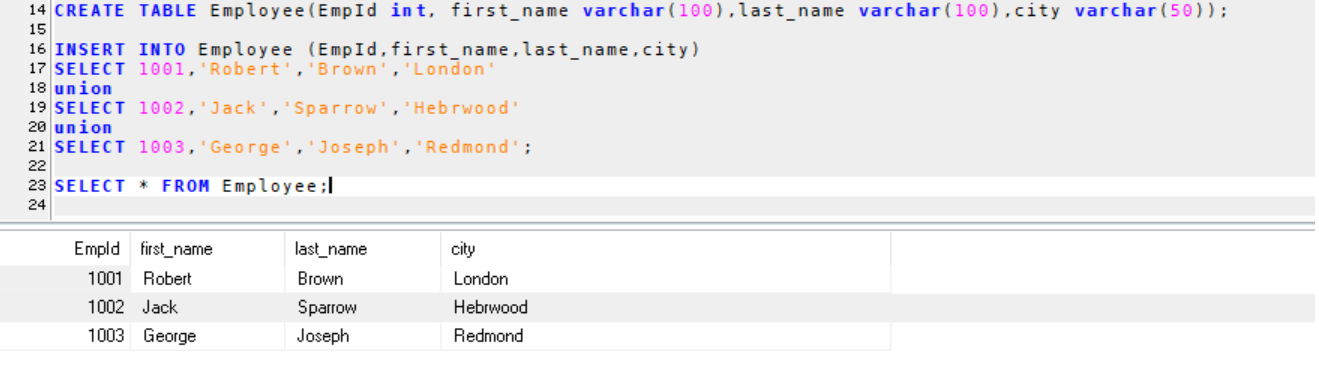
    SELECT * FROM Employee;

    Step 2: 

    Method 1 : Set a variable and use it in a SELECT statement

    Execute the SET command in the query window, this means your setting a variable @row_number to 0.

    SET @row_number:=0;

    Now, execute the below query you get the query results with row number 1,2,3 etc.

    SELECT @row_number:=@row_number+1 AS row_number,
           EmpId,
           first_name,
           last_name,
           city 
    FROM Employee

    ORDER BY EmpId;
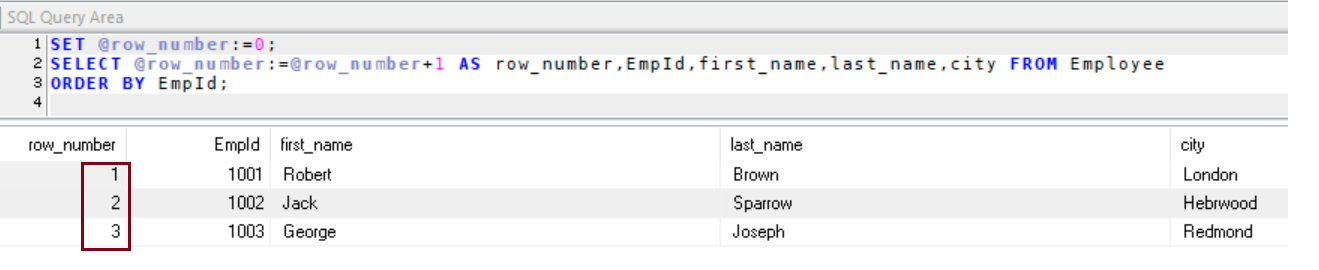
    At this point, you might have got a question why should we user variable and setting to 0, what happens if we do not set variable to 0 ? what will be output of @row_number? To answer your question @row_number gives the server sequence number which will be unique and every time you run the query @row_number value will keep increasing.

    Let’s say, you are running the query first time and it has 3 rows, row_number will be 1,2,3.  The second time you run the same query now row_number will be 4,5,6. The third time you run the same query now row_number will be 7,8,9 as it goes on becomes the unwanted results isn’t?  


    Step 3:  

    Method 2 : Use a variable as a table and cross join it with the source table

    Isn’t possible to get it done with single query ? Yes, possible using cross join

    SELECT (@row_number:=@row_number+1) AS row_number,
           EmpId,
           first_name,
           last_name,
           city 
    FROM Employee,
    (SELECT @row_number:=0) AS x

    ORDER BY EmpId;


    Note that yellow , highlighted and then placed select statement as assigning @row_number to 0 value.  
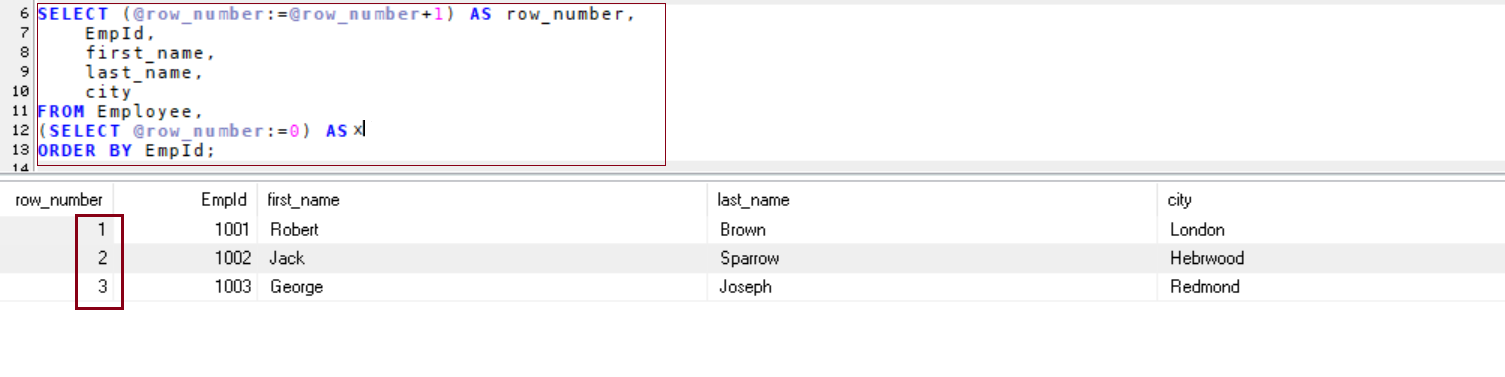

    If you run your application without next step you will encounter an fatal error  @row_number must be defined.
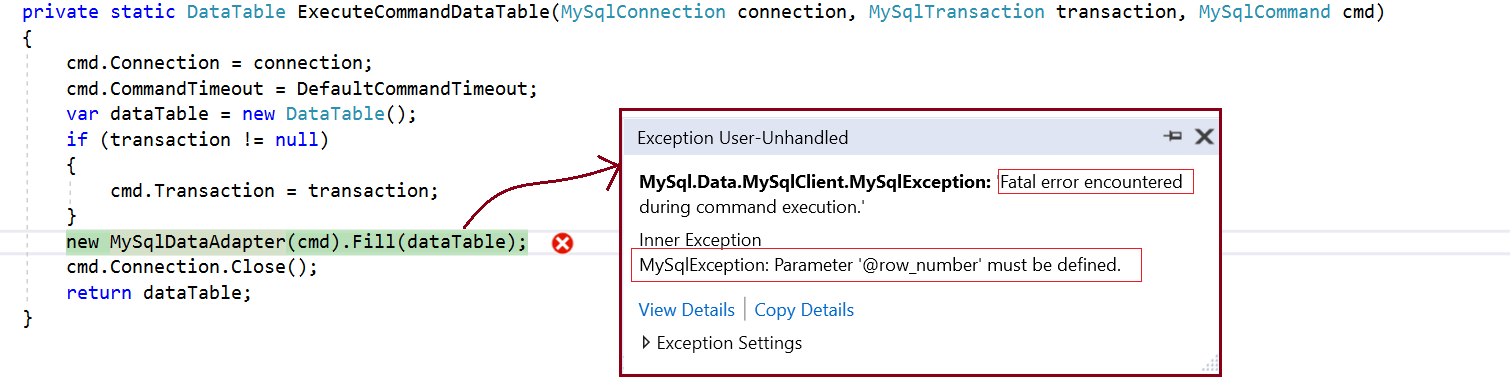

    Important Note on Next Step
    When using @ parameter variables in query mysql query browser will give you results, how about .NET or other development environment will fail when executing the query.
    So what to do ?
    Append property called Allow user variable into your mysql connection string  as below

    Your connection string should have as high lighted

    Database=testdb;Data Source=localhost;User Id=root;Password=****;Allow User Variables=True;

    Summary

    In this article we have seen, how Microsoft SQL Server and MySQL work on getting row_number in the select query. Please make sure you can follow step by steps example and include Allow user variables=true in your connection string to complete the results

    Reference:

    MYSQL Could not load assembly

    MySQL How to backup database?

    How to Change MySQL Password?

    MySQL How to find Command Line Client?

    MySQL How to solve MySQL Query Browser Issue?

    Find @Medium

    What is ASP.NET Core MVC ?

    What is ASP.NET Core MVC ?


    The ASP.NET Core MVC framework is a lightweight, open source, highly testable presentation framework optimized for use with ASP.NET Core.
    ASP.NET Core MVC provides a patterns-based way to build dynamic websites that enables a clean separation of concerns. It gives you full control over markup, supports TDD-friendly development and uses the latest web standards.
    Features

    ASP.NET Core MVC includes the following:
    • Routing
    • Model binding
    • Model validation
    • Dependency injection
    • Filters
    • Areas
    • Web APIs
    • Testability
    • Razor view engine
    • Strongly typed views
    • Tag Helpers
    • View Components

    Routing

    ASP.NET Core MVC is built on top of ASP.NET Core’s routing, a powerful URL-mapping component that lets you build applications that have comprehensible and searchable URLs. This enables you to define your application’s URL naming patterns that work well for search engine optimization (SEO) and for link generation, without regard for how the files on your web server are organized. You can define your routes using a convenient route template syntax that supports route value constraints, defaults and optional values.
    Convention-based routing enables you to globally define the URL formats that your application accepts and how each of those formats maps to a specific action method on given controller. When an incoming request is received, the routing engine parses the URL and matches it to one of the defined URL formats, and then calls the associated controller’s action method. 

    routes.MapRoute(name: “Default”, template: “{controller=Home}/{action=Index}/{id?}”);


    Attribute routing enables you to specify routing information by decorating your controllers and actions with attributes
    that define your application’s routes. This means that your route definitions are placed next to the controller and
    action with which they’re associated.

     [Route(“api/[controller]”)]
    public class ProductsController : Controller
    {
        [HttpGet(“{id}”)]
        public IActionResult GetProduct(int id)
        {
          …
        }
    }


    Model Binding

    ASP.NET Core MVC model binding converts client request data (form values, route data, query string parameters,
    HTTP headers) into objects that the controller can handle. As a result, your controller logic doesn’t have to do the
    work of figuring out the incoming request data; it simply has the data as parameters to its action methods. 

    public async Task Login(LoginViewModel model, 
    string returnUrl = null) { … }


    Model validation
    ASP.NET Core MVC supports validation by decorating your model object with data annotation validation attributes. The validation attributes are checked on the client side before values are posted to the server, as well as on the server before the controller action is called.

    using System.ComponentModel.DataAnnotations;
    public class LoginViewModel
    {
        [Required]
        [EmailAddress]
        public string Email { get; set; }

        [Required]
        [DataType(DataType.Password)]
        public string Password { get; set; }

        [Display(Name = “Remember me?”)]
        public bool RememberMe { get; set; }
    }


    The Login Controller will validate above model as we defined attributes like [Required] [EmailAddress] all should be valid to process in controller. 

    public async Task Login(LoginViewModel model, 
    string returnUrl = null)
    {
        if (ModelState.IsValid)
        {
          // work with the model
        }
        // At this point, something failed, redisplay form
        return View(model);
    }


    The framework handles validating request data both on the client and on the server. Validation logic specified on model types is added to the rendered views.

    Dependency Injection

    ASP.NET Core has built-in support for dependency injection (DI). In ASP.NET Core MVC, controllers can request needed services through their constructors, allowing them to follow the Explicit Dependencies Principle.
    Your app can also use dependency injection in view files, using the @inject directive:
    @inject SomeService ServiceName


        @ServiceName.GetTitle


    @ServiceName.GetTitle


    Filters

    Filters help developers encapsulate cross-cutting concerns, like exception handling or authorization. Filters enable running custom pre- and post-processing logic for action methods, and can be configured to run at certain points within the execution pipeline for a given request. Filters can be applied to controllers or actions as attributes (or can be run globally). Several filters (such as Authorize) are included in the framework. [Authorize] is the attribute that is used to create MVC authorization filters.
    [Authorize]
    public class AccountController : Controller

    Areas

     Areas provide a way to partition a large ASP.NET Core MVC Web app into smaller functional groupings. An area is an MVC structure inside an application. In an MVC project, logical components like Model, Controller, and View are kept in different folders, and MVC uses naming conventions to create the relationship between these components. For a large app, it may be advantageous to partition the app into separate high level areas of functionality. For instance, an e-commerce app with multiple business units, such as checkout, billing, and search etc. Each of these units have their own logical component views, controllers, and models.

    Web APIs

    In addition to being a great platform for building web sites, ASP.NET Core MVC has great support for building Web APIs. You can build services that reach a broad range of clients including browsers and mobile devices.
    The framework includes support for HTTP content-negotiation with built-in support to format data as JSON or XML. Write custom formatters to add support for your own formats.
    Use link generation to enable support for hypermedia. Easily enable support for cross-origin resource sharing (CORS) so that your Web APIs can be shared across multiple Web applications.

    Test ability

    The framework’s use of interfaces and dependency injection make it well-suited to unit testing, and the framework includes features (like a TestHost and InMemory provider for Entity Framework) that make integration tests quick and easy as well. Learn more about how to test controller logic.

    Razor View Engine

    ASP.NET Core MVC views use the Razor view engine to render views. Razor is a compact, expressive and fluid template markup language for defining views using embedded C# code. Razor is used to dynamically generate web content on the server. You can cleanly mix server code with client side content and code.


          @for (int i = 0; i < 5; i++) {
             

    • List item @i

    •     }


    Using the Razor view engine you can define layouts, partial views and replaceable sections.

    Strongly typed views
    Razor views in MVC can be strongly typed based on your model. Controllers can pass a strongly typed model to views enabling your views to have type checking and Intellisense support.
    For example, the following view renders a model of type IEnumerable:

    @model IEnumerable


          @foreach (Product p in Model)
          {
             

    • @p.Name

    •     }


    Tag Helpers

    Tag Helpers enable server side code to participate in creating and rendering HTML elements in Razor files. You can use tag helpers to define custom tags (for example, ) or to modify the behavior of existing tags (for example, ). Tag Helpers bind to specific elements based on the element name and its attributes. They provide the benefits of server-side rendering while still preserving an HTML editing experience.
    There are many built-in Tag Helpers for common tasks – such as creating forms, links, loading assets and more – and even more available in public GitHub repositories and as NuGet packages. Tag Helpers are authored in C#, and they target HTML elements based on element name, attribute name, or parent tag. For example, the built-in LinkTagHelper can be used to create a link to the Login action of the AccountsController:


        Thank you for confirming your email.
        Please <a asp-controller="Account" 
    asp-action=”Login”>Click here to Log in.


    The EnvironmentTagHelper can be used to include different scripts in your views (for example, raw or minified) based on the runtime environment, such as Development, Staging, or Production:


        <script src="https://ajax.aspnetcdn.com/ajax/jquery/jquery-2.1.4.min.js&quot;
                asp-fallback-src=”~/lib/jquery/dist/jquery.min.js”
                asp-fallback-test=”window.jQuery”>


    Tag Helpers provide an HTML-friendly development experience and a rich IntelliSense environment for creating HTML and Razor markup. Most of the built-in Tag Helpers target existing HTML elements and provide server-side attributes for the element.

    Summary

    As a developer if you have been working on ASP.NET older version this is the time for moving to ASP.NET MVC and I am sure you will overwhelmed and never get back to traditional development ASP.NET.   

    Build client web apps with C#

    Build client web apps with C#

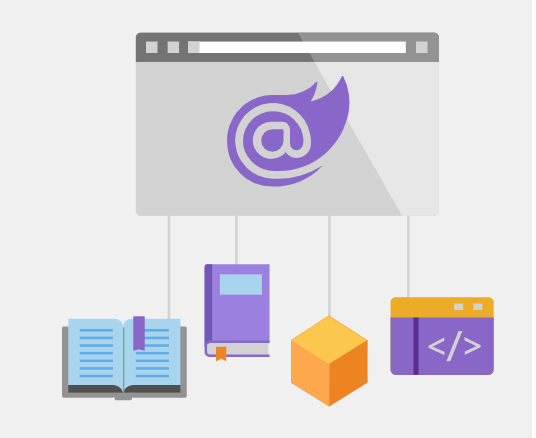
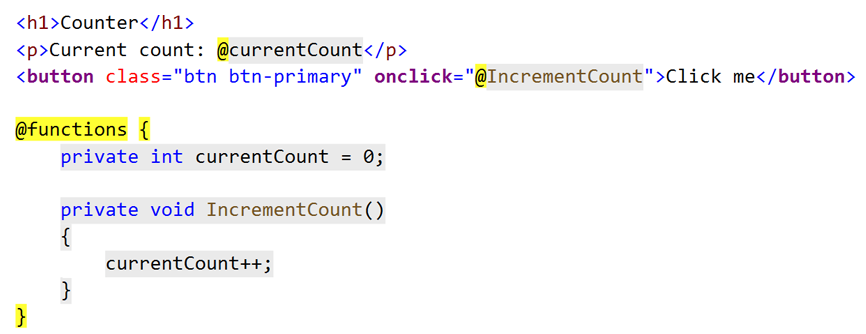
    Blazor lets you build interactive web UIs using C# instead of JavaScript. Blazor apps are composed of reusable web UI components implemented using C#, HTML, and CSS. Both client and server code is written in C#, allowing you to share code and libraries.
    Blazor is a feature of ASP.NET, the popular web development framework that extends the .NET developer platform with tools and libraries for building web apps.
    Run on WebAssembly or the server
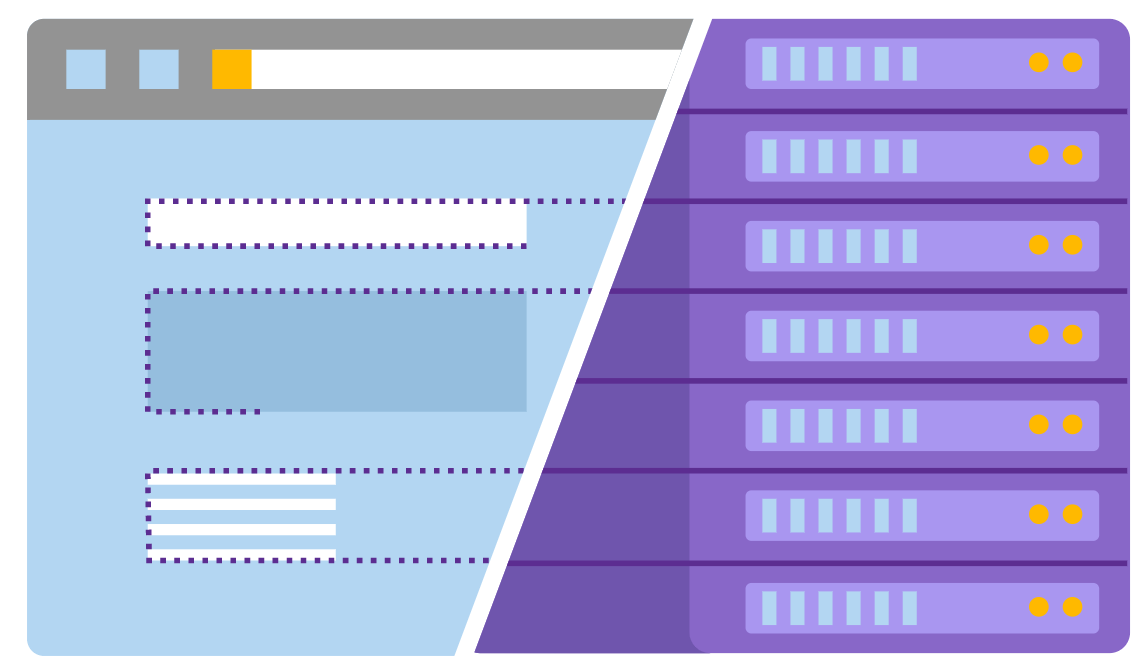
    Blazor can run your client-side C# code directly in the browser, using Web Assembly. Because it’s real .NET running on WebAssembly, you can re-use code and libraries from server-side parts of your application.

    Alternatively, Blazor can run your client logic on the server. Client UI events are sent back to the server using SignalR – a real-time messaging framework. Once execution completes, the required UI changes are sent to the client and merged into the DOM.
    Built on open web standards
    Blazor uses open web standards without plugins or code transpilation. Blazor works in all modern web browsers, including mobile browsers.
    (What is Transpilation ?)  Transpilation is the process of converting code written in one programming language to another. Transpilation to JavaScript is a common approach to enable languages to run in the browser, but often provides limited functionality.

    Code running in the browser executes in the same security sandbox as JavaScript frameworks. Blazor code executing on the server has the flexibility to do anything you would normally do on the server, such as connecting directly to a database.
    Share code and libraries 

    Blazor apps can use existing .NET libraries, thanks to .NET Standard—a formal specification of .NET APIs that are common across all .NET implementations.
    .NET Standard allows the same code and libraries to be used on the server, in the browser, or anywhere you write .NET code.

    JavaScript interop

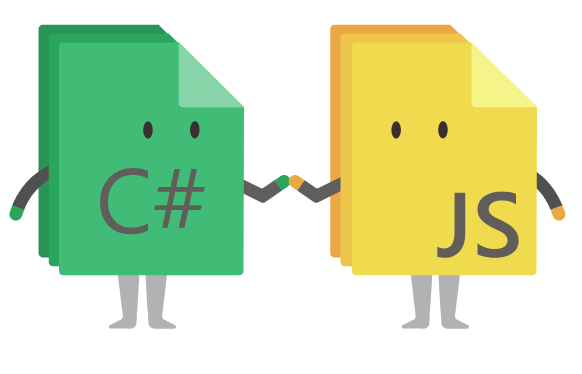
    Your C# code can easily call JavaScript APIs and libraries. You can continue to use the large ecosystem of JavaScript libraries that exist for client side UI while writing your logic in C#.
    When using server-side code execution, Blazor takes care of seamlessly executing any JavaScript code on the client.

    Free tools for every operating system 

    Visual Studio and Visual Studio Code provide a great Blazor development experience on Windows, Linux, and macOS. 

    If you prefer to use a different editor, there are .NET command line tools that allow you to work with the editor of your choice. 

    Summary 


    Find more information on what new features available in Blazor  Asp.Net Core features with Blazor

    Downloads available at https://aka.ms/blazor-ebook

    ASP.NET Core and Blazor updates in .NET Core 3.0

    ASP.NET Core and Blazor updates in .NET Core 3.0

    Free and available .NET Core 3.0 and ready for production use, and  has lots of great new features for building amazing web apps with ASP.NET Core and Blazor.

    What is Blazor find more info on What is Blazor?
    Some of the big New Features in this release of ASP.NET Core include:
    • Build rich interactive client-side web apps using C# instead of JavaScript using Blazor).
    • Create high-performance backend services with gRPC.
    • SignalR now has support for automatic reconnection and client-to-server streaming.
    • Generate strongly typed client code for Web APIs with OpenAPI documents.
    • Endpoint routing integrated through the framework.
    • HTTP/2 now enabled by default in Kestrel.
    • Authentication support for Web APIs and single-page apps integrated with IdentityServer
    • Support for certificate and Kerberos authentication.
    • Integrates with the new System.Text.Json serializer.
    • New generic host sets up common hosting services like dependency injection (DI), configuration, and logging.
    • New Worker Service template for building long-running services.
    • New EventCounters created for requests per second, total requests, current requests, and failed requests.
    • Startup errors now reported to the Windows Event Log when hosted in IIS.
    • Request pipeline integrated with with System.IO.Pipelines.
    • Performance improvements across the entire stack.
    You can find all the details about what’s new in ASP.NET Core in .NET Core 3.0 in the What’s new in ASP.NET Core 3.0 topic.

    As to summarize, the core features and basic concepts are available here Building Web app client UI using Blazor with C#

    Design a site like this with WordPress.com
    Get started