What’s the easiest way to make money online?


If you want to EARN Money, you don’t need a world great idea. But, it’s your blog should be focused on something specific.
Remember are unique and so your idea.
But, you have unique experiences. You have a distinct voice. And, you probably have a vibrant personality that will attract others like your family and friends.
When it comes to choosing your blog’s niche, there are 2 key questions to ask yourself. 
1. Do I enjoy learning about this topic?
If you don’t love the topic, it’ll show in your writing. You shouldn’t even start a blog if you don’t love what you’re blogging about.
Whatever topic you pick, you need to love it, and naturally curious about it. If not, you’ll run out of ideas quickly. Most importantly, you won’t be able to consistently create content that will build your audience.
If you are still lost, think about what your family and friends come to you for when seeking advice? It might be fitness, recipes or relationship advice. You know best.
2. Are there others who are interested in the same things?
You might feel like the only 23-year-old who’s obsessed with knitting. But, there are others out there. Do a quick Google search and you’ll find 539,000 results aimed at people just like you. 
You might be wondering if your idea is too quirky. Or, maybe it’s too broad? If you want to start a travel blog, stay away from generic words like “travel.” Choose a more specific topic, like “backpacking.”
I can give you a million examples, but it’s better if I show you. Enter a keyword below and 
you’ll have a data-backed answer right away. 
Name your blog and get web hosting
This is a fun and important step, because your blog name is your brand. It’s how you’ll be remembered. But, don’t overthink it. The key is to take action and gain momentum.
When you’re starting a blog from scratch, you need two things.
The first is a domain name. This is your blog’s name. Domain names will run you roughly $10/year. If you don’t find the right domain name, no worries you can still start a blog and change your name later.
The second is web hosting. Web hosting is a service that allows your blog to be accessed through the internet. Without web hosting, your blog can’t be seen online. Without a domain name, your blog won’t have an address. The two are inseparable.
There are plenty of web hosting companies to choose from. Prices generally range from $3 – $1000/month. When naming your blog, you may want to take these tips into consideration.
Choose a .com over others. They’re easier to remember.
Aim for 2-3 words. Unfortunately, most, if not all single word domains are taken.
Try to use a keyword that represents what your blog is about. This helps people quickly identify your blog’s niche and helps search engines distinguish what your blog is about.
Avoid using numbers and hyphens. They are difficult to remember.
Go for something memorable or catchy.
For personal brands, use your name or a variation of it. 
Install WordPress – your blogging software
You can’t start a blog without blogging software. I run all of my blogs on WordPress because it’s user-friendly, free and powerful.
Even without a technical bone in your body, you can install WordPress in exactly 5 clicks.
Here’s how.
After you get your free domain and hosting account, you can log in and use your first click on the “Install WordPress” icon.
Choose the “do it yourself” version and click the “Install” button. Your last two clicks will be for acknowledging their terms of service and finalizing your install.
Design your blog with a WordPress theme
In the blogging world, WordPress designs are called themes.
Out of the box, your blog will look something like this:
It isn’t the fanciest design out there, but it’s workable.
There are thousands of themes to choose from. But, it can be easy to get trapped in “Shiny Object Syndrome” and not walk away with anything.
You can swap out your theme any time, so don’t get too caught up with the bells and whistles.
First, you need to log into your WordPress admin. You can access this by going to yourdomain Resources and Information..
Here, you’ll need to enter your user credentials to log in.
If you’re new to WordPress, the dashboard might look a little daunting at first, but you’ll be an expert with a little practice.
To install a new theme, hover over the “Appearance” menu in the sidebar and click “Themes.”
WordPress comes with a few themes – their “Twenty-[Year]” themes.
Instead, we’ll search for flashier themes that will instantly make your eyes twinkle. Click the “Add New” button at the top to get access to thousands of WordPress themes.
Your taste and mine might be different. Fortunately, WordPress has a “Feature Filter” that lets you search for something that will fit your style.
After applying the filters, you’ll see amazing themes that would otherwise cost thousands of dollars in design fees.
If you click on the theme’s thumbnail, you can get an instant preview of what your blog will look like. Evaluate if it fits both your personal style and the topic that you’ll be covering.
Once you’re satisfied with the sneak peek, click the “Install” button.
Once the installation is complete, click the “Activate” button and you’re all set.
If you can’t find a theme that you like, there are premium themes that you can purchase from sites like:
  • Themeforest.
  • Elegant Themes.
  • StudioPress.
  • Thrive Themes.
Optimize for Search Engine Traffic
Search engine optimization (SEO) is a multi-billion dollar industry.
SEO is the process of optimizing your website to be found in search engines for particular keywords and phrases.
I attribute a good portion of my success to being easily discoverable for relevant search terms, which has helped me build my networks and net worth.
If you’re new to SEO, then this new feat may seem daunting.
But, WordPress makes it insanely simple to optimize the technical aspects of your blog.
The majority of your SEO efforts will be to create engaging content for real people. Whether that’s through text, videos or images, your job as a blogger is to spark a relationship with your readers.
There’s more than I can explain here, so check out this guide: SEO Made Simple: A Step-by-Step Guide
Brainstorm blog topics
On the technical side, your blog is all set up and ready to go. When it comes to topic generation, the world is your oyster.
The majority of your blog posts will come from personal experiences, passions, successes, failures and new learnings.
People use questions as search queries, like:
  • What should I write about?
  • What to blog about?
  • Should I start blogging?
So naturally, you should start off with some questions of your own. I use a series of questions and a systematic process to come up with my blog topic ideas.
No need to worry. It’s not complicated and it won’t take very much time.
By following this process, you should be able to come up with about 50 working topics within a half hour of distraction-free time.
Pull out a pen and paper or open up your favorite word processing tool.
The goal of this exercise is to get 10 answers for each question. If you can think of more, note them all.
It’s time to look through the lens of your readers with these 5 questions.
1. “What excites, intrigues or stirs passion in my readers?”
Examples:
  • As a golfer, I get excited by hitting my driver farther. I’m fascinated by mental performance. I’m passionate about healthy living.
  • As a new stay-at-home mom, I get excited by budget-friendly ideas for the family. I’m intrigued by sleep-training. I’m passionate about homeschooling.
  • As an avid camper, I get excited about finding undervalued camping sites. I’m intrigued by survival tactics. I’m passionate about minimalist living.
2. “What are common challenges my readers go through?”
Examples:
  • Golfers might struggle with slicing the ball.
  • Stay-at-home moms may find meal planning challenging.
  • Campers might struggle with packing light.
3. “What character traits do my readers possess?
Example:
  • Serious golfers have emotional stability.
  • Moms are patient and have a sense of humor.
  • Campers are adventurous and resourceful.
4. “What do your readers love about your niche?”
Example:
  • Golfers love the challenge of perfection.
  • Stay-at-home moms love being a part of their child’s mental, physical and emotional development.
  • Campers love time away from the busy city life.
5. “What do your readers hate about your niche?”
Examples:
  • Golfers hate playing with partners who complain all day long.
  • Stay-at-home moms hate being looked down on by others.
  • Campers hate getting eaten alive.
You get the point. Now that you have about 50 answers, you can begin dissecting blog post ideas from each answer. The sky is the limit.
Here are a few examples you can extract from one answer in your list:
  • Cure Your Slice: The Foolproof Guide To Hit The Fairway Every Time
  • 3 Reasons Why You’re Slicing The Ball And One Stupid Simple Fix
  • Never Slice Again: 9 Drills To Play Like The Pros
  • 7 Training Aids For Dead Straight Ball Flight
  • How To Shoot Even Par With A Nasty Slice.
Try to come up with a catchy headline that will draw your readers in and then throw them a one-two punch in the rest of your content.
Write your first masterpiece
WordPress uses an intuitive editor, similar to your favorite word processing tools. New entries are created directly from your WordPress admin.
Click on “Posts” in the left sidebar.
This will populate a list of your blog entries in descending order. Since we’re working with a fresh install, you won’t see anything here.
To create a new entry, click the “Add New” button at the top or in the sidebar.
First things first. Add one of the titles that you developed in your brainstorming session in the title text box. Immediately after, WordPress will create a permalink based on the keywords used in your title.
You can start typing the body of your article in the large text area and write until you feel happy with your content.
You’ll want to add visual assets to your blog posts as well. Images help engage readers and can often illustrate concepts better than words.
To add new images, ensure that your text cursor is in the place where you want your image to appear. Click the “Add Media” button.
Here’s a quick checklist to consider, before you hit the publish button:
  • Speak in a conversational tone.
  • Content flows naturally.
  • Easy on the eyes with adequate white space.
  • Use headings to separate sections.
  • Bullet points and lists.
  • Check for typos and grammatical errors.
If everything checks out, you’re ready to publish your first blog post.
Create an editorial calendar
One of the fatal mistakes I see bloggers make is to blog only when they “feel like it.”
They forget that new fans want more content and they fail to deliver.
Unforeseen circumstances will arise. You’ll let a new Netflix series take over the time that you could have spent blogging.
Life will continue to throw curveballs at you, whether you start blogging or not.
Consistency is undervalued and it needs to be something you prioritize.
I’ve written over a thousand articles and it’s not because I type 7,000 words per minute.
It’s because I follow an editorial calendar without compromise.
Schedules aren’t just for big publications like The New York Times and the Huffington Post. They’re for regular people like you and me.
Think about it like this.
If you have a doctor’s appointment in your calendar or even a lunch date with a friend, you’re going to honor it. Worst case scenario, you’ll reschedule for the next available time-slot.
Editorial calendars work in a similar fashion.
They make aggressive goals reachable in micro steps. They keep you organized. They streamline your social media and email marketing efforts.
And, you’ll be surprised at how an editorial calendar can even help you grow in character and integrity.
We are creatures of habit.
The better you keep your dates, the faster you’ll grow your audience.
So, how do you get started and how much will it cost?
Nada.
Just open up a new Excel spreadsheet. If you have multiple writers, you can share the sheet using Google drive.
Start with four columns – Publishing Date, Title, Keyword and Notes.
Your needs might be different than mine, so feel free to add additional columns as needed. Common additions might include “Author,””Category” and “Persona.”
The simpler you keep it, the easier it will be to digest and follow.
Look through your calendar on your iPhone, Android or the one hanging on your fridge. How often can you post?
Monthly? Weekly? Daily?
Be conservative with your goals, because consistently missing deadlines can lead to quitting altogether.
Next, go through the answers that you came up with in your brainstorming session and add them under the “Title” column.
Your titles don’t need to be perfect yet. Throw in a working headline that you can spruce up before publishing.
Sometimes, the best headlines come after you’ve written your article. You’ll have a crystal clear picture of what your story is about and who it is for.
The “Keyword” column is intended for SEO purposes. If you’re targeting specific keyword phrases that you’d like to rank for, add those in there.
If nothing comes to mind, you can do some keyword research later on.
Finally, there’s the “Notes” column.
This section is a perfect place to write down brilliant ideas that come to mind. Notes also act as a great tool to stay focused on the topic at hand and tackle it coherently.
You should be able to write up a set of 25 blog post topics with deadlines that you’re confident about keeping.
That’s almost half a year’s worth of blog posts for a weekly writer.
Okay. You have the editorial, but you’re still missing the calendar.
Go to Google Calendars and set up a new calendar. You can do this by clicking the down arrow to the right of “My Calendars.”
Click “Create New Calendar” and add a name, description and time zone. You can share this calendar with other participants on your team.
If you don’t have team members, share it with your spouse or a good friend who is willing to keep you accountable to your goals.
After you’ve filled out the essential information, click “Create Calendar” and get acquainted with your new best friend.
Make sure that your calendar is selected in the left sidebar and change your schedule view to weekly.
Click on a time slot under a day and add your blog post title as the “Event Title.” I recommend that you set a notification for a couple of days before the publishing date.
If you only write whenever it’s convenient, you’re heading down a dangerous road.
You’ll eventually run out of ideas, lose motivation and forget about the drive you once had to start your own blog.
Editorial calendars are a quick fix for a blogger’s procrastination.
Conclusion
Starting a blog is easy. Creating one that will be successful and make money requires hard work, dedication and grit.
But, the rewards far outweigh the risks.
Blogs are affordable and more accessible today than they have ever been before.
Like anything else in life, there will be obstacles that attempt to throw you off course. But, I encourage you to go forward with your passion and share it through your own blog.
Everything that you need to get started is here.
As you begin your blogging journey, remember that you’re speaking to humans.
Be you. Be adventurous. Be honest and transparent.
Reference from https://neilpatel.com/


10 cool things at Microsoft Build 2019

Photo of people walking by a sign that says Microsoft Build inside the Washington State Convention Center in Seattle

Microsoft Build is underway in Seattle, and this year’s premier developer conference is focused on empowering developers of all kinds, from experienced computer scientists to tech beginners with big ideas. We’re sharing the latest on Microsoft platforms, tools and services that are making it easier to create and innovate using AI and mixed reality with the intelligent cloud and the intelligent edge, as well as helping people and organizations do more each day.
Here’s a peek at some of the event’s highlights:

1.

Check out the new features in Microsoft Edge built on Chromium OSS that will make it easier to collect, organize and share content, and give you additional privacy controls to make your own decisions about how third parties can track you.

2.

See how technology is helping Starbucks and their baristas deliver great customer experiencesincluding managing predictive maintenance on coffee machines with Azure Sphere; giving personalized recommendations to customers via the Starbucks mobile app with reinforcement learning on Azure; and powering digital traceability efforts to track coffee beans from farm to store with Azure blockchain service.
Photo of Starbucks barista smiling and making an espresso drink
Technology is helping Starbucks and their baristas deliver great customer experiences (Photo courtesy of Starbucks)

3.

Read about Fluid Framework, a web-based platform expected to be available later this year that will give teams new ways to create together, enabling content to be deconstructed and reconstructed into modular components and allowing intelligent agents to work alongside people to co-author, provide photo suggestions, translate data and more.

4. 

Learn more about Microsoft’s vision for intelligent agents that leverage breakthroughs in conversational AI and machine learning pioneered by Semantic Machines, which Microsoft acquired in May 2018. We’re showcasing a calendaring application of the technology that can make organizing your day with an intelligent assistant a more natural and powerful experience, and the same technology will eventually be integrated into our conversational AI moving forward across all of Microsoft’s products and services.
Photo of woman holding smartphone and screenshots of her calendaring activity in the background
A woman engages in a smooth, back-and-forth dialogue with an intelligent assistant that helps her juggle upcoming appointments on her calendar.

5.

See how more everyday uses of AI in Microsoft 365 and Office 365 can help improve productivity, including Ideas in Word for Word Online, which can help you easily design and present polished documents, and Microsoft Search, a new enterprise search experience that applies AI technology from Bing and deep personalized insights surfaced by the Microsoft Graph.

6. 

Learn more about a new platform that can help make it easier for companies to create autonomous systems, whether it’s a robot that can help in life-threatening situations, a drone that can inspect remote equipment or systems that can autonomously calibrate factory equipment. The first component in this platform is now available in a limited preview program.
Photo of snake-like robot with two lights on the front
An experimental version of the Sarcos Guardian S, a robot that can be used in disaster recovery or for industrial inspections, uses Microsoft’s autonomous systems platform. (Photo by Dan DeLong)

7.

Learn what developers will be able to do with Microsoft Graph data connecta service that helps organizations bring together productivity data from the Microsoft Graph with their own business data securely, providing new opportunities to create insight-powered apps while helping address the challenges of moving and managing large amounts of data.

8.

Learn about the new tools and capabilities in Azure AI for developers and data scientists, including Ink Recognizer, which lets developers embed digital ink recognition, an advanced speech-to-text capability that transcribes meeting conversations in real time so participants can fully engage in the discussion and know who said what later on.

9.

See how the new Azure Blockchain Service will empower developers, letting them deploy a fully managed consortium network with a few simple clicks and use built-in governance to add new members, set permissions and authenticate user applications. They’ll also be able to monitor their network’s health and activity.

10.

Check out IoT Plug and Play. One of the greatest challenges customers face when deploying Internet of Things solutions broadly is connecting their IoT devices to the cloud. IoT Plug and Play offers a new open modeling language to help make this happen seamlessly, as well as a large ecosystem of partner-certified devices that simply work, with over a dozen certified devices now available.

Amazon Mechanical Turk

Amazon MTurk

What is Amazon Mechanical Turk?

Amazon Mechanical Turk (MTurk) is a marketplace for work that requires human intelligence. The Mechanical Turk service gives businesses access to a diverse, on-demand, scalable workforce and gives Workers a selection of thousands of tasks to complete whenever it’s convenient.
Amazon Mechanical Turk is based on the idea that there are still many things that human beings can do much more effectively than computers, such as identifying objects in a photo or video, performing data de-duplication, transcribing audio recordings, or researching data details. Traditionally, tasks like this have been accomplished by hiring a large temporary workforce (which is time consuming, expensive, and difficult to scale) or have gone undone.

Where does the name Mechanical Turk come from?

In 1769, Hungarian nobleman Wolfgang von Kempelen astonished Europe by building a mechanical chess-playing automaton that defeated nearly every opponent it faced. A life-sized wooden mannequin, adorned with a fur-trimmed robe and a turban, Kempelen’s “Turk” was seated behind a cabinet and toured Europe confounding such brilliant challengers as Benjamin Franklin and Napoleon Bonaparte. To persuade skeptical audiences, Kempelen would slide open the cabinet’s doors to reveal the intricate set of gears, cogs and springs that powered his invention. He convinced them that he had built a machine that made decisions using artificial intelligence. What they did not know was the secret behind the Mechanical Turk: a chess master cleverly concealed inside.

What is a HIT?

A Human Intelligence Task, or HIT, is a question that needs an answer. A HIT represents a single, self-contained task that a Worker can work on, submit an answer, and collect a reward for completing.

How do I create a Worker account on MTurk?

Click the “Get Started with Amazon Mechanical Turk” link in the upper right corner of the Worker website. You will be asked to provide your name, email address, and password. In addition, you will be asked to agree to the Amazon Mechanical Turk Participation Agreement and provide your country of residence. We will send you an email when your registration request is accepted.

Where can I view and edit my name, email address, and password?

You can view and edit your account information by accessing your Account Settings page. Your MTurk Worker account is associated with your Amazon.com account so you will be redirected to Amazon.com to change your name, email address, and password.

My country of residence is the United States. Where can I view and edit my contact address and bank account information?

You can view and edit your contact address and bank account information via Amazon Payments.

My country of residence is outside the United States. Where can I view and edit my contact address and bank account information?

You can view and edit your contact address on Amazon.com. If you have the option to transfer your earnings to your local bank account, you can change your bank account information here.

Getting Paid

How do I get paid?

When the Requester approves your submitted HIT, Amazon Mechanical Turk account will automatically display your earnings on the Dashboard and Earnings pages.
As a security requirement, if you are a new Worker, there is an initial holding period before rewards are transferred to your earnings balance. Your rewards are held until you have been active on Amazon Mechanical Turk for at least 10 days, starting from the day you submit your first HIT. After this initial holding period, you will be able to disperse funds from your earnings balance by visiting the Earnings page. You are limited to one transfer per calendar day.
U.S. Workers: You can transfer your earnings to your Amazon Payments account or to an Amazon.com gift card. You can disburse to your bank account as soon as your earnings are transferred to your Amazon Payments account.
Non-U.S. International Workers You can transfer earnings to an Amazon.com gift card. Eligible Workers may also receive the option to disburse earnings to a US bank account obtained from Hyperwallet or from another third party service provider.

How do I transfer my earnings to my bank account?

Go to the Earnings page. You will see your amount available for transfer. Enter the amount you wish to transfer and click the Continue button. You will need to enter your password when prompted for your Amazon Payments account. Once logged in, follow the steps to transfer the funds to your bank account.
If this is the first time you have transferred money to a bank account, you will need to enter your bank account information. Follow the instructions to enter your bank routing and account numbers in the form provided.

7 ways to boost productivity in the workplace

7 ways to boost productivity in the workplace


Is your team too busy to get any work done?

It may sound like a silly question but consider how many days you’ve started the morning with a set to-do list, then got waylaid by meetings and emails. Sound familiar?

Over a third of 3,500 employees we polled admitted to being productive for less than 30 hours a week. That means a whole day a week they’re ‘working’ but not actually getting any work done.

Our research – ‘Why your workforce isn’t working’ – revealed some intriguing takeaways about what workers really want, and the secrets to productivity in the workplace.  Here are seven findings from the research, and what they reveal about how to boost productivity.

Offer flexible and remote working

Over 81% of employees we polled placed importance and value on flexible working. Today, employees are ‘always on’, work longer hours, and – at times – weekends too. Yet the traditional model of being in the office 9-5 often remains the same.

Why shouldn’t employees work from 7 am and finish earlier if they’re more productive in the mornings, or have international calls first thing? Why should parents have to miss the school run just to be seen to be in the office, when they may be working long evenings too?

Consider your flexible and remote working policy. If it doesn’t reflect how your employees want to work, it’s time to update it.

Cut the ping pong tables and office games

A tiny 5% of respondents said they value office games such as ping pong tables in the office. In fact, more than half of employees (53%) think that having games in the office is distracting and decreases productivity.

Yet, unbelievably, 40% of employers think games in the office are important to employees.
It’s time to re-consider office games in the workplace and ask yourself: are they really adding value?  

Show employees you value them

What employees did want instead of office games was clear from our research: feeling valued in the workplace and being recognized for the work that they did. 66% of respondents said this was vital.

Workers aren’t motivated by company outings. They just want their employer to say: ‘great job’. They want to feel that their company values the contribution that they’re making.

There are endless possibilities to the ways that companies can do this – from training for managers to continuous feedback, or peer-to-peer recognition, right down to just saying a simple ‘thanks’.

You support your workers’ well being

39% of respondents said they believed HR and People teams could do more to improve wellness at work.
Whether its offering subsidized gym membership, providing free fruit, ensuring there is mental health support in place, or demonstrating at a wider level that the company values employee’s 

health and well being through an instilled culture, this is something that’s flying up the priorities list for workers. Companies need to pay attention.

Ask employees for their views

Want to know how to boost productivity in the workplace? Ask your employees what they think.
Just 12% of workers we spoke to are asked on a regular basis what would improve their experiences at work. Almost half (47%) had never been asked at all.
Make sure that you demonstrate you’re listening by communicating what and how you’re changing – and the rationale if some things can’t be changed right now.

Understand what the data says

34% of workers felt organizations could increase their value if they used data to inform HR and people decisions.

When it comes to understanding more about your people and their productivity, look at your highest performing teams and see what patterns and insights emerge. Apply data science to your people analytics to test hypotheses and understand what they respond positively to.

Companies don’t make decisions on supply chains, their finances or distribution based on intuition – so why should they do the same when it comes to their people?

The single most important thing? Create a great employee experience

The standout takeaway from our research about productivity in the workplace? A staggering 78% of respondents said their overall experience as an employee had a huge impact on productivity.

This jumps even higher to 92% for the younger generations – a demographic that will make up 50% of the workforce by 2020.

Everyone is driven by different goals and aspirations. Some employees are motivated by money. Others want a great work-life balance. The needs might be different for someone who just moved to New York versus someone who wants to start settling down.

Organizations need to make it a priority to know what motivates and drives their people and work with them to create positive experiences so that they are doing their best work.

Being a ‘People Company’: your guiding principle

A third of employees saw their HR or People’s team role in creating positive experiences at work – so HR and People teams need to lead this cultural transformation. However, they can’t do it alone. The entire top table needs to be responsible for delivering positive experiences across the workforce.

The better an employee’s experience at work, the more engaged they are, the more productive they can be, and the more the business benefits.

Ultimately, it comes down to whether your business is a People Company. Are you an organization where your people are the most valuable asset, and where company success is dependent on their workforce being successful?

Do your people know this is the case? Most importantly, do you demonstrate it to them?


What is latest news from Microsoft?

Microsoft Announcement 
Microsoft is moving  “Microsoft Virtual Academy to  Microsoft Learning Center
Microsoft has decided on the knowledge base “Microsoft Virtual Academy” could have better way of acquiring knowledge and has come up with new proposal of learning idea. And thus going forward Microsoft Virtual Academy will be retired by 10th June 2019. 

 
To simplify your tech training journey, we are consolidating our learning resources and retiring Microsoft Virtual Academy on June 10, 2019. On that date, the full site and all courses are retiring. To earn your certificates of completion, be sure to finish any courses by June 10, 2019, and download certificates and transcripts by that same date.  

How to use the Power BI service ?

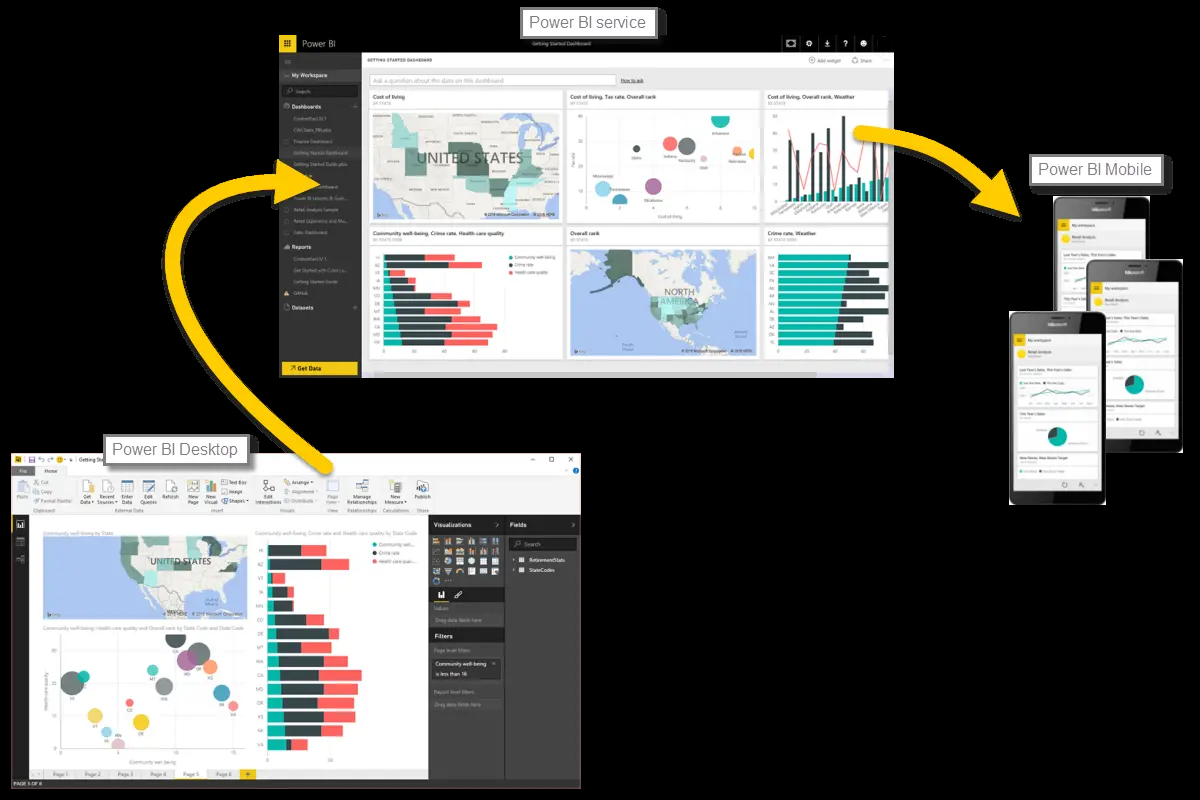
Microsoft Power BI is to create a report in Power BI Desktop, publish it to the Power BI service, and then share it with others, so that they can view it in the service or on a mobile app.
But because some people begin in the Power BI service, let’s take a quick look at that first, and learn about an easy and popular way to quickly create visuals in Power BI: apps.
An app is a collection of preset, ready-made visuals and reports that are shared with an entire organization. Using an app is like microwaving a TV dinner or ordering a fast-food value meal: you just have to press a few buttons or make a few comments, and you’re quickly served a collection of entrees designed to go together, all presented in a tidy, ready-to-consume package.
So, let’s take a quick look at apps, the service, and how it works. We’ll go into more detail about apps (and the service) in upcoming modules, but you can think of this as a taste to whet your appetite.

Create out-of-box dashboards with cloud services

With Power BI, connecting to data is easy. From the Power BI service, you can just select the Get Data button in the lower-left corner of the home page.
Power BI dashboards
The canvas (the area in the center of the Power BI service) shows you the available sources of data in the Power BI service. In addition to common data sources like Microsoft Excel files, databases, or Microsoft Azure data, Power BI can just as easily connect to a whole assortment of software services (also called SaaS providers or cloud services): Salesforce, Facebook, Google Analytics, and more.
Power BI Get Data
For these software services, the Power BI service provides a collection of ready-made visuals that are pre-arranged on dashboards and reports for your organization. This collection of visuals is called an app. Apps get you up and running quickly, with data and dashboards that your organization has created for you. For example, when you use the GitHub app, Power BI connects to your GitHub account (after you provide your credentials) and then populates a predefined collection of visuals and dashboards in Power BI.
There are apps for all sorts of online services. The following image shows a page of apps that are available for different online services, in alphabetical order. This page is shown when you select the Get button in the Services box (shown in the previous image). As you can see from the following image, there are many apps to choose from.
Power BI services
For our purposes, we’ll choose GitHub. GitHub is an application for online source control. When you select the Get it nowbutton in the box for the GitHub app, the Connect to GitHub dialog box appears. Note that Github does not support Internet Explorer, so make sure you are working in another browser.
The GitHub app
After you enter the information and credentials for the GitHub app, installation of the app begins.
Import data
After the data is loaded, the predefined GitHub app dashboard appears.
Power BI app loaded
In addition to the app dashboard, the report that was generated (as part of the GitHub app) and used to create the dashboard is available, as is the dataset (the collection of data pulled from GitHub) that was created during data import and used to create the GitHub report.
Power BI navigation
On the dashboard, you can select any of the visuals and interact with them. As you do so, all the other visuals on the page will respond. For example, when the May 2018 bar is selected in the Pull Requests (by month) visual, the other visuals on the page adjust to reflect that selection.
Power BI navigation

Update data in the Power BI service

You can also choose to update the dataset for an app, or other data that you use in Power BI. To set update settings, select the schedule update icon for the dataset to update, and then use the menu that appears. You can also select the update icon (the circle with an arrow) next to the schedule update icon to update the dataset immediately.
Scheduling an update for dashboards
The Datasets tab is selected on the Settings page that appears. In the right pane, select the arrow next to Scheduled refresh to expand that section. The Settings dialog box appears on the canvas, letting you set the update settings that meet your needs.
Scheduling refresh buttons

Building blocks of Power BI

Everything you do in Microsoft Power BI can be broken down into a few basic building blocks. After you understand these building blocks, you can expand on each of them and begin creating elaborate and complex reports. After all, even seemingly complex things are built from basic building blocks. For example, buildings are created with wood, steel, concrete and glass, and cars are made from metal, fabric, and rubber. Of course, buildings and cars can also be basic or elaborate, depending on how those basic building blocks are arranged.
Let’s take a look at these basic building blocks, discuss some simple things that can be built with them, and then get a glimpse into how complex things can also be created.
Here are the basic building blocks in Power BI:
  • Visualizations
  • Datasets
  • Reports
  • Dashboards
  • Tiles

Visualizations

visualization (sometimes also referred to as a visual) is a visual representation of data, like a chart, a color-coded map, or other interesting things you can create to represent your data visually. Power BI has all sorts of visualization types, and more are coming all the time. The following image shows a collection of different visualizations that were created in the Power BI service.
Power BI visualizations
Visualizations can be simple, like a single number that represents something significant, or they can be visually complex, like a gradient-colored map that shows voter sentiment about a certain social issue or concern. The goal of a visual is to present data in a way that provides context and insights, both of which would probably be difficult to discern from a raw table of numbers or text.

Datasets

dataset is a collection of data that Power BI uses to create its visualizations.
You can have a simple dataset that’s based on a single table from a Microsoft Excel workbook, similar to what’s shown in the following image.
Power BI datasets
Datasets can also be a combination of many different sources, which you can filter and combine to provide a unique collection of data (a dataset) for use in Power BI.
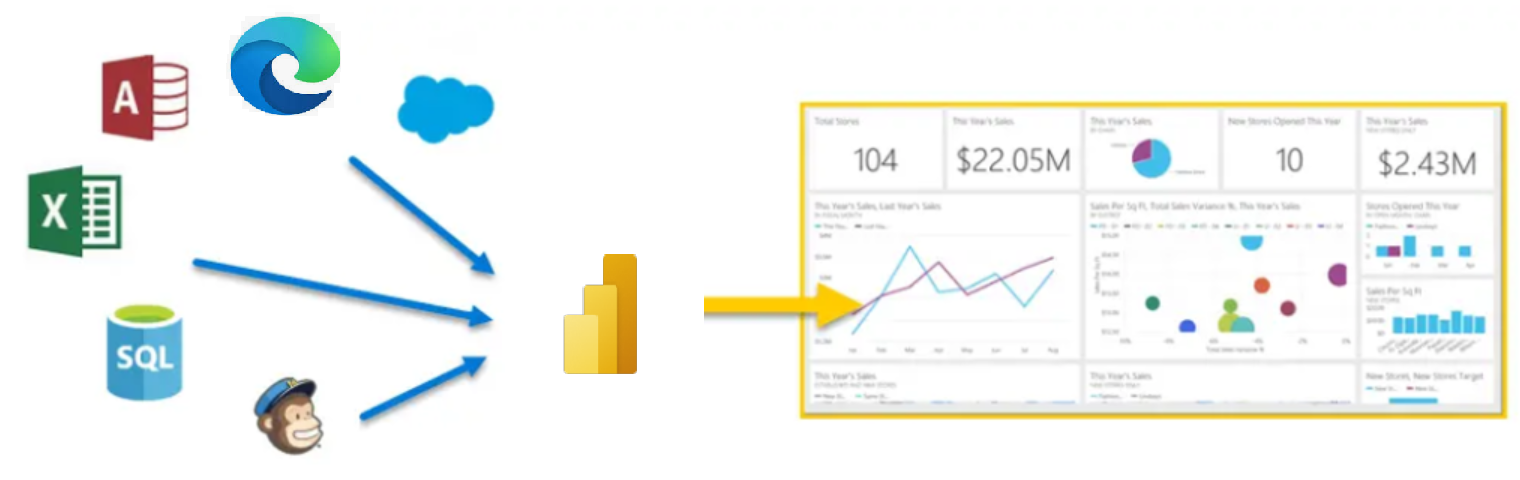
For example, you can create a dataset from three database fields, one website table, an Excel table, and online results of an email marketing campaign. That unique combination is still considered a single dataset, even though it was pulled together from many different sources.
Filtering data before bringing it into Power BI lets you focus on the data that matters to you. For example, you can filter your contact database so that only customers who received emails from the marketing campaign are included in the dataset. You can then create visuals based on that subset (the filtered collection) of customers who were included in the campaign. Filtering helps you focus your data—and your efforts.
An important and enabling part of Power BI is the multitude of data connectors that are included. Whether the data you want is in Excel or a Microsoft SQL Server database, in Azure or Oracle, or in a service like Facebook, Salesforce, or MailChimp, Power BI has built-in data connectors that let you easily connect to that data, filter it if necessary, and bring it into your dataset.
After you have a dataset, you can begin creating visualizations that show different portions of it in different ways, and gain insights based on what you see. That’s where reports come in.

Reports

In Power BI, a report is a collection of visualizations that appear together on one or more pages. Just like any other report you might create for a sales presentation or write for a school assignment, a report in Power BI is a collection of items that are related to each other. The following image shows a report in Power BI Desktop—in this case, it’s the fifth page in a six-page report. You can also create reports in the Power BI service.
Power BI reports
Reports let you create many visualizations, on multiple pages if necessary, and let you arrange those visualization in whatever way best tells your story.
You might have a report about quarterly sales, product growth in a particular segment, or migration patterns of polar bears. Whatever your subject, reports let you gather and organize your visualizations onto one page (or more).

Dashboards

When you’re ready to share a single page from a report, or a collection of visualizations, you create a dashboard. Much like the dashboard in a car, a Power BI dashboard is a collection of visuals from a single page that you can share with others. Often, it’s a selected group of visuals that provide quick insight into the data or story you’re trying to present.
A dashboard must fit on a single page, often called a canvas (the canvas is the blank backdrop in Power BI Desktop or the service, where you put visualizations). Think of it like the canvas that an artist or painter uses—a workspace where you create, combine, and rework interesting and compelling visuals. You can share dashboards with other users or groups, who can then interact with your dashboards when they’re in the Power BI service or on their mobile device.

Tiles

In Power BI, a tile is a single visualization on a report or a dashboard. It’s the rectangular box that holds an individual visual. In the following image, you see one tile (highlighted by a bright box), which is also surrounded by other tiles.
Power BI tiles
When you’re creating a report or a dashboard in Power BI, you can move or arrange tiles however you want. You can make them bigger, change their height or width, and snuggle them up to other tiles.
When you’re viewing, or consuming, a dashboard or report—which means you’re not the creator or owner, but the report or dashboard has been shared with you—you can interact with it, but you can’t change the size of the tiles or their arrangement.

All together now

Those are the basics of Power BI and its building blocks. Let’s take a moment to review.
Power BI is a collection of services, apps, and connectors that lets you connect to your data, wherever it happens to reside, filter it if necessary, and then bring it into Power BI to create compelling visualizations that you can share with others.
Now that you’ve learned about the handful of basic building blocks of Power BI, it should be clear that you can create datasets that make sense to you and create visually compelling reports that tell your story. Stories told with Power BI don’t have to be complex, or complicated, to be compelling.
For some people, using a single Excel table in a data-set and then sharing a dashboard with their team will be an incredibly valuable way to use Power BI.
For others, the value of Power BI will be in using real-time Azure SQL Data Warehouse tables that combine with other databases and real-time sources to build a moment-by-moment dataset.
For both groups, the process is the same: create datasets, build compelling visuals, and share them with others. And the result is also the same for both groups: harness your ever-expanding world of data, and turn it into actionable insights.
Whether your data insights require straightforward or complex datasets, Power BI helps you get started quickly and can expand with your needs to be as complex as your world of data requires. And because Power BI is a Microsoft product, you can count on it being robust, extensible, Microsoft Office–friendly, and enterprise-ready.

How Power BI matches your role ?

How you use Power BI might depend on your role on a project or a team. And other people, in other roles, might use Power BI differently, which is just fine.
For example, you might view reports and dashboards in the Power BI service, and that might be all you do with Power BI. But your number-crunching, business-report-creating coworker might make extensive use of Power BI Desktop (and publish Power BI Desktop reports to the Power BI service, which you then use to view them). And another coworker, in sales, might mainly use her Power BI phone app to monitor progress on her sales quotas and drill into new sales lead details.
You also might use each element of Power BI at different times, depending on what you’re trying to achieve, or what your role is for a given project or effort.
Perhaps you view inventory and manufacturing progress in a real-time dashboard in the service, and also use Power BI Desktop to create reports for your own team about customer engagement statistics. How you use Power BI can depend on which feature or service of Power BI is the best tool for your situation. But each part of Power BI is available to you, which is why it’s so flexible and compelling.
We discuss these three elements—Desktop, the service, and Mobile apps—in more detail later. In upcoming units and modules, we’ll also create reports in Power BI Desktop, share them in the service, and eventually drill into them on our mobile device.

The flow of work in Power BI

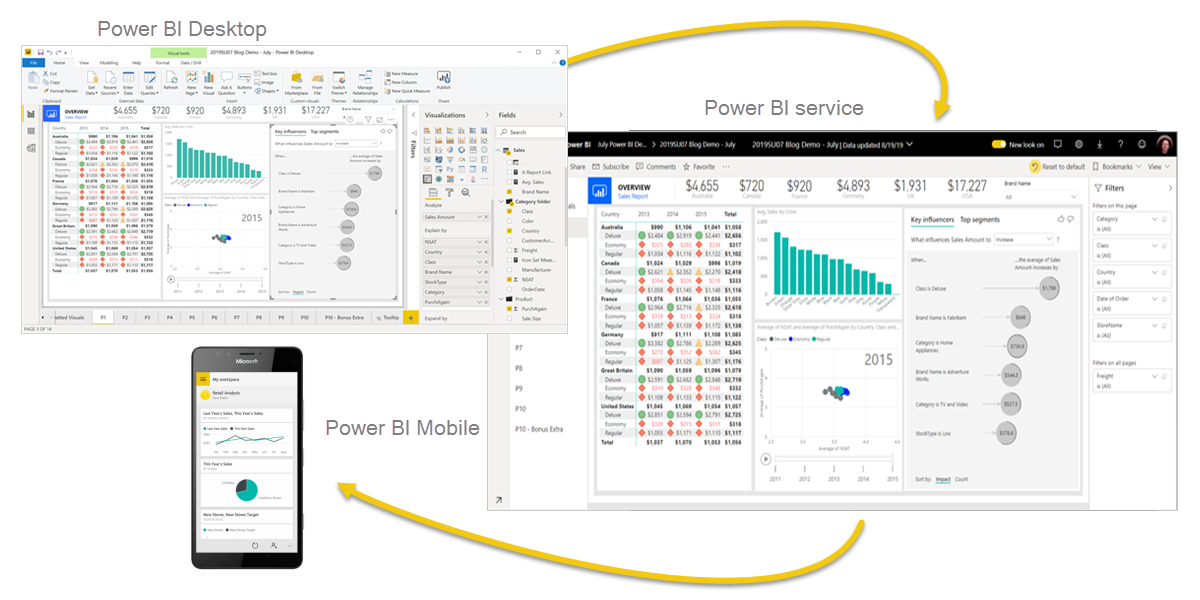
A common flow of work in Power BI begins in Power BI Desktop, where a report is created. That report is then published to the Power BI service and finally shared, so that users of Power BI Mobile apps can consume the information.
It doesn’t always happen that way, and that’s okay. But we’ll use that flow to help you learn the different parts of Power BI and how they complement each other.
Okay, now that we have an overview of this module, what Power BI is, and its three main elements, let’s take a look at what it’s like to use Power BI.

Use Power BI

As you learn about all the things that can be done with Power BI, keep in mind that all these activities, and all the analysis that’s done with Power BI, generally follow a common flow. The common flow of activity in Power BI looks like this:
  1. Bring data into Power BI Desktop, and create a report.
  2. Publish to the Power BI service, where you can create new visualizations or build dashboards.
  3. Share dashboards with others, especially people who are on the go.
  4. View and interact with shared dashboards and reports in Power BI Mobile apps.
Power BI cycle of use
As mentioned earlier, you might spend all your time in the Power BI service, viewing visuals and reports that have been created by others. And that’s just fine. Someone else on your team might spend all her time in Power BI Desktop, which is fine too. To help you understand the full continuum of Power BI and what it can do, we’ll show you all of it. Then you can decide how to use it to your best advantage.

What is Microsoft Power BI ?

Microsoft Power BI (Business Intelligence) is a collection of software services, apps, and connectors that work together to turn your unrelated sources of data into coherent, visually immersive, and interactive insights. Whether your data is a simple Microsoft Excel workbook, or a collection of cloud-based and on-premises hybrid data warehouses, Power BI lets you easily connect to your data sources, visualize (or discover) what’s important, and share that with anyone or everyone you want.
How Power BI works with other data
Power BI can be simple and fast, capable of creating quick insights from an Excel workbook or a local database. But Power BI is also robust and enterprise-grade, ready not only for extensive modeling and real-time analytics, but also for custom development. Therefore, it can be your personal report and visualization tool, but can also serve as the analytics and decision engine behind group projects, divisions, or entire corporations.

The parts of Power BI

Power BI consists of a Microsoft Windows desktop application called Power BI Desktop, an online SaaS (Software as a Service) service called the Power BI service, and mobile Power BI apps that are available on Windows phones and tablets, and also on Apple iOS and Google Android devices.
The parts of Power BI
These three elements—Desktop, the service, and Mobile apps—are designed to let people create, share, and consume business insights in the way that serves them, or their role, most effectively

Man dupes travel portals, books 1,500 air tickets without paying a penny

A Master mind in hacking payment gateway

Image result for air ticket payment gateway hack


Who is he ? 

a man smiling for the camera: Rajpratap Parmar

A 27-year-old man from Madhya Pradesh allegedly took at least four travel portals for a ride by booking over 1,500 air tickets without paying a single penny in the last two years. Rajpratap Parmar, who was arrested on Tuesday along with two of his relatives from Datia, made around Rs 2 crore in the process, said the police.

After discovering an alleged loophole in the payment gateway system of the portals, Parmar — a Class XII passout — approached several travel agencies across the country and provided them air tickets at 80 per cent of the rates available in the market.

How it is started to find ?

The alleged scam was unearthed when a Mumbai-based man booked air tickets for Goa. When he took a printout of the air tickets, he realized that the mobile number and email address mentioned on the ticket did not belong to him. Also, the amount that he had paid and the one mentioned on the ticket was different.

Suspecting that his details may have been compromised, the man submitted written complaints to unit 7 of the Mumbai Crime Branch. During investigation, unit VII in charge Satish Taware and Inspector N Sridhankar found out about the scam.

An officer probing the case said that nearly two years ago, Parmar, who hails from Datia in MP, discovered a loophole in some of the travel portal payment gateways.

How he Hacked ?

Parmar would accept travel bookings from agents across the country. While filling in the person’s details online, he would enter an incorrect mobile number and email address to ensure that the person does not receive any alert. He would then enter his card details and continue with the transaction till he had to select between the submit and cancel payment options,” he added.
At this point, he would click on cancel and press escape several times to freeze the page. He would then tinker with the URL and write ‘success’ in the URL address bar to show that he had clicked on submit. He then copy-pasted the link to another tab and pressed enter. The system would think the payment has been authorized and generate tickets without Parmar actually having made any payment,” the officer said.
Image result for air ticket payment gateway hack
Design a site like this with WordPress.com
Get started